
Why do so many people feel so “out of sorts” in today’s world?
Because it has grown so complex it can be hard to find our balance.
This causes us to feel “stuck”. How can we change this? Find out more below.
Take the first step to find out more here
Stories to help America reconcile their culture and reassess their social contract

Why do so many people feel so “out of sorts” in today’s world?
Because it has grown so complex it can be hard to find our balance.
This causes us to feel “stuck”. How can we change this? Find out more below.
Take the first step to find out more here
What if the answers to solving our problems are right in front of us? Maybe we just need to take another look. Reaching into the past, seeing ideas another way, can help us uncover how best to move forward. This has been my focus for the past few years, and here I will attempt to describe my findings in the plainest way possible. This series will dive into the details of Maslow’s theory, what it is, where it came from, and most importantly, how it can be used to help us understand the mysteries of our current environment. Using this as a prism, we will examine our past, the path we took collectively to arise at our present, and what our options are for our collective future. Part One provides an overview of the theory and sets the tone for the remainder of the series.
Many people have heard of, or have even studied, Maslow’s hierarchy, but often it is nothing more than a mention of human behavior or a short blurb in a text book. Rarely do we truly understand it at it’s depths, or what it really looks like in practice.
Maslow’s hierarchy of needs is an idea in psychology proposed by Abraham Maslow in his 1943 paper “A theory of Human Motivation” in the journal Psychological Review. Wikipedia
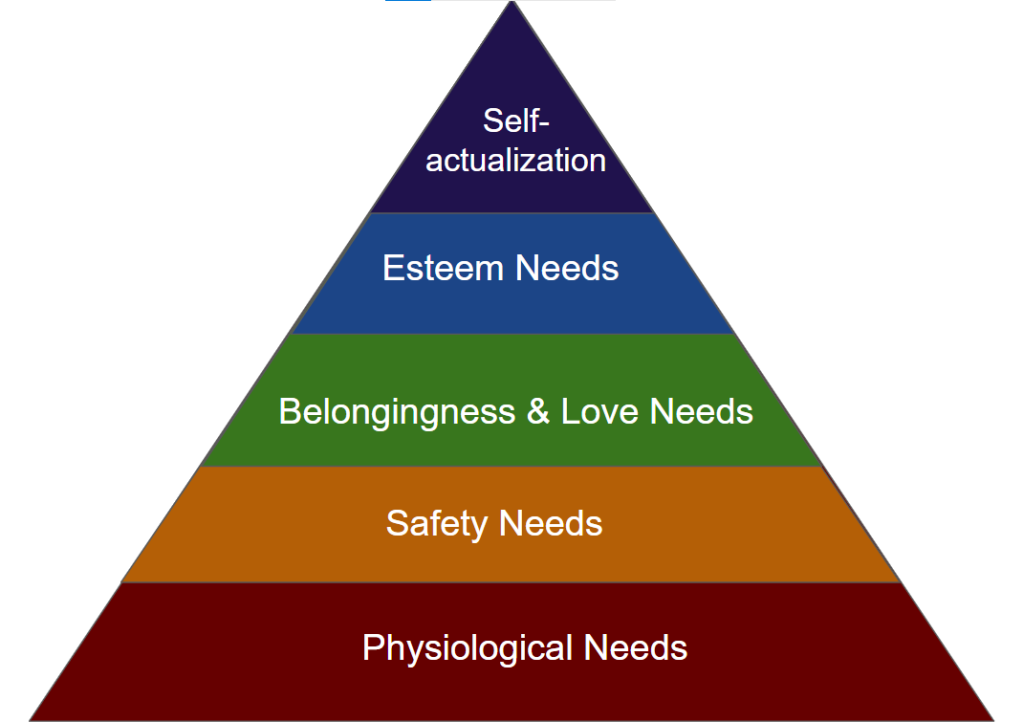
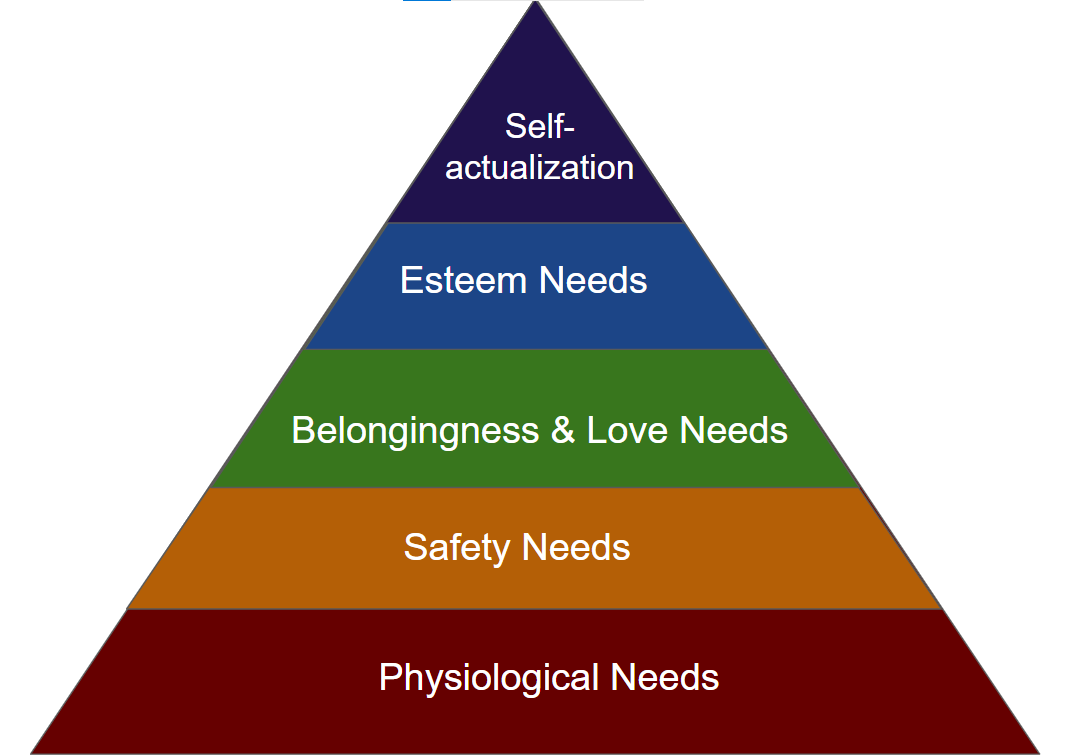
Comprised of five levels: Physiological needs (aka Survival), Safety, Belonging, Esteem and Self-actualization, Maslow’s hierarchy is seen as a way to explain our trek through life. Seen as a pyramid, each level can be compared to a video game, where each level must be completed prior to focusing on the next. Each level is so consuming that even if the needs above are offered the subject may ignore or not understand them as they focus on the level they are working to satisfy.
As with most things, each level comes with their own tradeoffs, as well as repercussions to ourselves and our place in society if we are unable to meet them.
Normally, Maslow’s theory has been focused on an individual perspective; something each of us work through during our lifetime. However, I believe that throughout history, all humans have worked to fulfill these needs both individually and as a group (comprised of one’s family, community, nation and/or world) in both conscious and unconscious ways.



Our world is an organism, and has many attributes that we could ascribe to a human being. Many theorize that we also have a shared consciousness affected by our feelings, thoughts and actions. Our world can grow to be harmonious or hellish depending on what we value, how we treat each other and what we digest. Just like we need to keep our own bodies healthy, it is extremely important for us all to keep our nations healthy as well. Given the ability to be healthy and find fulfillment, we then collectively are able to have empathy for our neighbor and want our citizens to attain their highest and best.
However, when our bodies are sick we do not function well and become divisive and angry. Illness leaves us often unable to think clearly and we portray negative emotions such as anxiety, fear, stress, depression and judgement. The same happens to our society when we have an inordinate amount of people in our community that are unwell and are struggling to be well. When we have many who are unable to achieve the basic needs in life, feel safe and feel like they belong, we will all suffer the consequences sooner or later. This is why it is important to study our society as a whole using these theories to provide us a lay of the land.


Seeing the world in this way allows us to formulate an understanding of the problems we face. While one theory is not the entire answer, this theory allows us a place to start. We will discuss other theories in future series and compare and contrast their affect on our world. As we see the connections and overlaps, we can start to construct a holistic view of where our nation is struggling and how best to overcome these obstacles to self-actualization. Seeing the truth of the matter helps us to create plans that allow us to diminish these issues.
For example, the Essential Elements of life focuses on helping our Explorers navigate the levels of Belonging, Esteem and Self-Actualization. With our Finding Fusion programs we help people to shed the layers of stress, find fulfillment and create a balanced life. Knowing where you, your community and your nation are at collectively helps us see where to start. Learning the necessary skills to move up the levels can help us find other ways to raise our collective vibrations and create a collective future that works for everyone.
Next week – Part Two – Our current level is Safety
©Maven Source International, LLC 2021 – All Rights Reserved
 Navigate our Complex World Successfully